Artificial intelligence has moved from experiment to an everyday tool in many small businesses. The question itself has shifted since 2020. It is no longer a question of whether small firms should adopt AI, but of how they can do so effectively and responsibly. Studies and systematic reviews report gains in productivity, service quality, and decision support across small and medium-sized enterprises (SMEs). How much AI actually helps is another matter; it varies widely and depends heavily on how ready the firm is and how good its data are (Oldemeyer et al., 2025; Schwaeke et al., 2025).
U.S. statistics tell the same story, with climbing usage. Drawing on the Census Bureau’s Business Trends and Outlook Survey, researchers found that firm-level AI use rose from about 3.7% in late 2023 to 5.4% in early 2024, with a higher rate expected later that year. Use rose with firm size; smaller firms generally trailed larger ones (Bonney et al., 2024; U.S. Census Bureau, 2024).
For small businesses, the decision to adopt AI depends on more than what the technology can do. It also relies on the cost of the AI, cost savings from using AI, staff skills, and whether the owner can see the value. Small firms rarely have a dedicated information technology (IT) or data science team, so the call usually rests with the owner-manager. As one retail owner put it:
“We don’t have an IT department. If AI doesn’t save time within a week or two, we just can’t justify it.”
That aligns with research showing that small firms favor tools that deliver visible, short-term benefits with minimal setup (Peretz-Andersson et al., 2024).
Problem Statement and Contribution
Research on AI in SMEs is growing fast, but much of it does one of two things. It either describes adoption—who is using AI and what predicts it—or it frames the topic around governance and ethics. What it rarely does is turn those findings into staged, low-cost steps a resource-constrained owner can actually take. Recent syntheses describe the literature as fragmented and inconsistent, spread across firm sizes, sectors, and methods without settling on practical pathways (Ayinaddis, 2025). The guidance written for the realities small firms face with AI (implementation barriers, tight resources, and responsible-use expectations) remains thin (Le Dinh et al., 2025).
This review takes on that gap directly. Rather than recataloguing what predicts adoption, it connects what the research and policy literature reports to what small firms can actually do, organized around the choices an owner-manager faces day-to-day: what to adopt first, how to build readiness, how to manage risk cheaply, and how to sequence spending. That is what sets it apart from existing SME–AI reviews, which tend to focus on bibliometric mapping or theoretical modeling. The aim is usable synthesis for practitioners, kept grounded in the evidence.
The point becomes clearer set against three recent syntheses. Oldemeyer et al. (2025) offer a PRISMA-based systematic review that catalogs the state of the art and lists numerous implementation challenges, but what emerges is a research agenda rather than staged guidance for owners. Ayinaddis (2025) offers a bibliometric and systematic analysis that sorts the field into ten adoption dimensions; useful for placing the literature, though pitched as constructs rather than actions. Schwaeke et al. (2025) document where SME adoption stands and what predicts it. All three are rigorous, and this review leans on all three. What this research adds is the layer they leave out; turning their findings into an incremental, low-cost pathway (thin-slice use cases, complementary assets, hybrid skills, minimum viable governance, and sequenced investment) that a small firm can follow.
This review is guided by three questions:
-
How are small businesses currently adopting AI?
-
What factors influence successful implementation?
-
What governance and capability practices are appropriate for resource-constrained firms?
What Is AI? Defining the Technologies Behind the Term
Because “AI” is used loosely in business conversations, it helps to break down the technologies an owner is likely to encounter. The distinctions that follow are practical rather than technical, and they recur throughout the review. Recent SME-focused work points to machine learning, natural language processing, and generative AI as the technologies that matter most for small firms (Le Dinh et al., 2025; Sarker et al., 2026).
Traditional analytics describes the past: it produces dashboards and reports that summarize what has already happened, such as last quarter’s sales or this month’s busiest hours. People set the logic; the software counts.
Automation follows fixed rules to handle repetitive steps. “When an invoice arrives, file it here and email a receipt.” It is fast and reliable, but it does not learn or interpret. It does exactly what it is told to do.
Machine learning (ML) finds patterns in past data to predict new cases—forecasting demand, flagging likely late payments, recommending products. Unlike fixed automation, ML improves as it sees more and better data. That is why data readiness matters so much for small firms.
Predictive analytics is ML put to forward-looking use: turning “what happened” into “what is likely next” to inform real decisions, like staffing or inventory.
Generative AI is the category most people have already met: the chat and writing assistants that make new content (text, images, code, summaries) from a prompt. It is the easiest category for small firms to start because it needs no infrastructure. But its output is probabilistic, and it can be confidently wrong (hallucinating). That is why human review keeps surfacing throughout this review.
The practical point is that these categories need different things and carry different risks. Automation needs clear rules and rarely surprises anyone; ML and predictive analytics need clean, accessible data; generative AI needs a human checking its output. Much of the difference in small-business results comes down to matching the right category to the right task.
Research Method: Narrative Review
This paper is a narrative, practitioner-oriented literature review. A narrative review is an accepted way to synthesize knowledge: it draws on a deliberately broad and mixed evidence base and organizes it by theme, offering interpretation and critique rather than the tightly scoped, protocol-driven procedure of a systematic review (Sukhera, 2022). The approach fits this review because the questions small-business owners face cut across academic research, policy guidance, and applied practice. The goal, too, is an interpretive, decision-oriented synthesis rather than the statistical pooling of comparable studies.
Sources were obtained through structured searches of scholarly databases and citation tracking, along with targeted reviews of institutional and policy publications and selected practitioner materials. The review concentrates on 2020–2025 to capture the post-2020 surge in AI capability and adoption, while admitting a few foundational earlier works where these apply directly.
Inclusion criteria. Sources were included if they (a) addressed AI adoption, implementation, impact, or governance; (b) were relevant to small and medium-sized enterprises, micro-firms, or small-business functional areas; and (c) were published in 2020–2025, with limited exceptions for seminal works.
Exclusion criteria. Sources were excluded if they covered only large-enterprise contexts with no transferable lessons for small firms, were promotional vendor material with little substance, or duplicated findings already covered by stronger, more authoritative sources.
Three source types were intentionally kept. Peer-reviewed studies carry the empirical and theoretical weight; institutional and policy reports, such as those from the OECD and the U.S. Census Bureau, provide governance context and adoption statistics. A small set of practitioner-oriented sources shows how adoption plays out in practice. As a practitioner-oriented review, this review retains grey and practitioner material but labels it clearly in the source profile (see Table 1) so readers can weigh it accordingly.
Use of practitioner observations. To make the patterns concrete, the review includes short illustrative observations from the author’s professional experience advising and working with small-business owners and managers. These observations appear in anonymized form, with identifying details removed. They are included to illustrate themes found in the reviewed literature, not to serve as systematically collected data. Where an observation describes the size of a benefit, that is, the practitioner’s own characterization, not a measured result.
Table 1 profiles the evidence base by source type. The corpus consists of the works listed in the References, sorted below.
The rest of the review follows the arc of an adoption decision. It opens with theoretical lenses explaining why small firms adopt AI, then works through the evidence on what drives adoption, the barriers that stall it, and the use-case patterns that dominate in practice. It then turns to a measured impact on performance, the governance and ethics practices that fit small firms, and a consolidated implementation framework, and closes with implications, future research, and a conclusion.
The sections that follow pull the reviewed literature together by theme. Each section covers where the evidence agrees and where it diverges, and then ties those patterns back to the situation a small firm is in.
Theoretical Perspectives on Small-Business AI Adoption
Research on AI adoption in SMEs leans most heavily on Technology–Organization–Environment (TOE) framework and Diffusion of Innovations (DOI) theory. TOE emphasizes technological fit, organizational capacity, and external pressure, whereas DOI emphasizes perceived advantage and complexity (Badghish & Soomro, 2024; Sánchez et al., 2025). A recent systematic review sorts the SME evidence into the following TOE-aligned dimensions: technology readiness, data requirements, skills and competencies, financial readiness, management support, and competitive mapping-out where adoption succeeds or stalls (Ayinaddis, 2025).
The resource-based view and dynamic capabilities offer complementary perspectives, focusing on how firms combine tools, data, and skills to create value (Peretz-Andersson et al., 2024). This matters most for small firms. There, the orchestration of resources, not the technology itself, usually decides whether an AI investment pays off. Across these lenses, the same theme surfaces: for small firms, the binding constraints are organizational and human, not technical.
Practitioner accounts back this up. A small manufacturing manager observed:
“The software wasn’t the hard part. Getting our data organized so it could actually work—that took months.”
That is the organizational readiness dimension that the TOE literature keeps pointing to.
Adoption Drivers in Small Businesses
Small firms adopt AI for more reasons than competitive pressure alone. Across the reviewed studies, the drivers most often reported fall into five themes: competitive and customer expectations, cost reduction and productivity, labor constraints, the opportunity to scale without adding headcount, and the accessibility of cloud-based tools. But none of these drivers matter without owner-manager commitment; that is what turns pressure into action.
Competitive pressure and customer expectations. Small firms increasingly see AI as a competitive necessity, a way to stay responsive and keep their marketing sharp. The perceived usefulness in marketing and customer service is a strong predictor of intent to adopt (Sánchez et al., 2025). Competitive and market pressures are, accordingly, among the ten adoption dimensions found across the SME literature (Ayinaddis, 2025).
“Clients expect instant responses now. If we don’t use AI tools to draft or analyze campaigns quickly, we lose business.”
Cost reduction and productivity. The strongest draw is doing more with what a firm already has. SME-focused work reports efficiency and decision-making gains across business functions as leading reasons firms adopt it (Le Dinh et al., 2025), which aligns with experimental evidence of large productivity gains in knowledge tasks (Brynjolfsson et al., 2025; Noy & Zhang, 2023).
Labor constraints and scaling without headcount. For firms that cannot easily hire—whether due to cost, local labor shortages, or the difficulty of recruiting specialized staff—AI offers a way to absorb work that would otherwise require another employee, especially in drafting, summarizing, scheduling, and first-line customer contact. This “do more with fewer people” logic matters most for micro-firms. That said, as the impact sections note, the labor effects of AI are uneven and context-dependent.
Accessibility through cloud tools. Cloud-based AI services have lowered technical barriers, allowing small firms to access generative text, analytics, and automation without buying infrastructure. That accessibility fits evidence that technological compatibility and cost reduction make adoption easier (Badghish & Soomro, 2024).
Owner-manager support as catalyst. In small firms, leadership commitment decides it; the push usually comes from the owner, not a formal process or committee. A restaurant owner explained:
“I started using AI to write menus and promotions myself. Once staff saw it worked, they adopted it too.”
That pattern supports research showing that management support is among the strongest predictors of adoption in small firms (Ayinaddis, 2025; Schwaeke et al., 2025).
Benefits of AI Adoption: Why It Can Be Worth It
Why would an owner take this on? The reviewed evidence points to four recurring benefits. The first is efficiency. AI reduces the time spent on drafting, summarizing, scheduling, and routine analysis, freeing owners and staff to focus on higher-value work (Brynjolfsson et al., 2025; Le Dinh et al., 2025). The second is better accuracy and consistency on structured tasks—documentation, categorization, first-pass financial processing—where automation trims manual error (Alruwaili & Mgammal, 2025). Third comes from lower per-unit operating costs, since the same team handles more volume without a corresponding rise in labor. The fourth benefit is faster turnaround and responsiveness, which feeds straight back into the customer-expectation driver discussed earlier.
These benefits are real, but they are not automatic. As the next sections show, they appear when tools are matched to well-defined tasks, paired with clean data, and kept under human review; Without those conditions, the same tools can add rework instead of removing it. AI is a lever, not a guarantee; what it returns depends on the conditions a firm builds around it.
Barriers to AI Adoption in Small Firms
If the drivers explain the pull toward AI, the barriers explain why adoption so often stalls. Across the reviewed studies, two dominate—limited skills and weak data readiness—followed by unclear business cases, cost concerns, employee resistance, and concerns about trust, privacy, and governance. Table 2 summarizes the full set of barriers; the subsections that follow turn to what the literature says about getting past them.
Skills and training gaps—and how firms address them. The most stubborn barrier is a lack of skills; SMEs often have no staff with data or AI expertise (Mathagu, 2024; Sánchez et al., 2025).
“The tools are easy to access, but knowing what prompts to use or how to check results—that’s where we struggle.”
The literature treats this gap as something firms can address rather than as a fixed limit. Targeted training and growing internal capability—an “AI champion” who learns the tools and coaches colleagues—reliably improves adoption (Ayinaddis, 2025). Vendor and external support reduce the need for in-house expertise, and choosing tools that require less configuration lowers the skill bar for a first deployment (Le Dinh et al., 2025). One further option, taken up in the capability-building discussions, is part-time or “fractional” AI leadership that gives a small firm strategic expertise without a full-time hire.
Data readiness. This is the second-most-reported barrier firms report. AI only works on accessible, clean data, yet small firms often keep their information in scattered systems.
“Our data was in spreadsheets, emails, everywhere. AI didn’t help until we cleaned it up.”
Academic studies name data quality and availability as central constraints in SME AI implementation (Le Dinh et al., 2025; Schwaeke et al., 2025).
Unclear business cases make these constraints worse, because many small firms cannot pin down the return on investment.
“We knew AI sounded promising, but we couldn’t see how it would directly increase revenue.”
Research likewise flags uncertainty about benefits as a key barrier (Sánchez et al., 2025), which is part of why the thin-slice, measurable-task approach in the framework below matters.
Employee resistance is a human barrier that is easy to overlook. Staff may fear the tools will replace them or may simply not trust unfamiliar output. The owner-led, demonstrate-then-expand pattern from the drivers section is one of the most effective ways firms reported getting past it. Concerns about trust, privacy, and governance remain significant as well:
“We worry about putting customer information into AI tools. We don’t know where it goes.”
Those worries align with the literature on governance and ethical risk for SMEs (OECD, 2024; Sarker et al., 2026), which the governance and ethics section addresses directly.
AI Use-Case Patterns Across Business Functions
The evidence shows SMEs adopt AI first on low-integration, high-visibility tasks, then move into more function-specific uses as confidence grows. Across functions, generative and predictive tools now reach marketing, customer service, administration, accounting and finance, operations, and human resources (Le Dinh et al., 2025). The pattern holds: adoption starts where the task is well defined and the output is easy to check.
Marketing. Marketing is one of the most common entry points. Beyond drafting copy, small firms use generative tools for content at scale, customer segmentation, and more personalized advertising, tailoring messages to audiences that previously required an agency (Le Dinh et al., 2025; Sánchez et al., 2025).
“AI drafts our social posts and emails. We just edit them.”
Customer service. Chatbots and automated replies take routine questions off staff so the team can focus on hard cases. The benefit is real, but the setup is not trivial: a chatbot is only as good as the information and guardrails, and a badly configured one frustrates customers more than it helps. Firms that get this right tend to start with narrow, common questions first—before widening the scope.
“Our chatbot handles basic questions so staff can focus on complex customers.”
Accounting and finance. AI is turning up in bookkeeping, invoice processing, financial reporting, fraud detection, and compliance support, with reported gains in efficiency and accuracy. Those gains come with caveats. The output needs professional review, and adoption depends on adequate training and proper controls (Alruwaili & Mgammal, 2025). For a small firm, the AI features already built into its accounting platform are usually a more realistic starting point than a standalone system.
Operations. In operations and logistics, AI helps with demand forecasting, scheduling, and routing—areas where even a small gain in prediction accuracy reduces idle time and waste (Le Dinh et al., 2025; Peretz-Andersson et al., 2024).
“It predicts our weekly demand better than spreadsheets.”
Human resources and administration. AI helps draft job descriptions, summarize documents, handle scheduling and run first-pass screening, easing the administrative load that falls heavily on owner-managers in small firms (Brynjolfsson et al., 2025). As in every other function, the standing requirement is human oversight, especially for any decision that affects people.
“We use AI to summarize meeting notes and create invoices.”
Two things cut across all of this. The tasks that pay off earliest share a profile—well-defined, inexpensive to integrate, with output a person can quickly check for function-specific value, especially in finance, operations, and HR. That dependency is exactly what the staged approach in the next section is built around.
AI Tools and Platforms in Practice
The tools small firms actually use share a profile, and that profile says more than any single product name. They are cloud-delivered, require little setup, cost a low monthly subscription fee, and target tasks whose output a non-specialist can judge for themselves. Table 3 maps representative early use cases to the kinds of tools firms use and the benefits they report. The products named are illustrative examples of widely used categories, not endorsements, and the landscape shifts quickly.
Small-business AI adoption is being shaped less by sophisticated, custom systems than by accessible, general-purpose tools aimed at narrow tasks. That ties directly to the review’s broader findings: the same low-integration profile that makes these tools easy to adopt is why early value clusters in marketing, service, and administration, and why deeper functional gains depend on the readiness investments described earlier. For owners, the lesson is to choose tools by task fit and how easily their output can be checked, not by feature lists.
Impact of AI on Small-Business Performance
Experimental research shows real productivity gains in knowledge tasks, and a recent OECD review of that evidence concludes that generative AI can raise productivity, while cautioning that the effect depends on user experience and task type (Brynjolfsson et al., 2025; Calvino et al., 2025; Noy & Zhang, 2023). The central finding from the small-business evidence, though, is that outcomes vary widely: the same tool that helps one firm can set back another. Practitioner experience catches both ends. A positive case:
“AI cut our proposal writing time considerably.”
A negative case:
“We tried AI marketing tools, but results were generic and hurt our brand.”
Empirical work shows the same split: generative AI can raise performance in some small firms and lower it in others, depending on task fit and how it is used; In one field experiment, higher-performing entrepreneurs gained from AI help while lower-performing ones did worse (Otis et al., 2024). The labor effects are mixed as well, not uniformly substitutive. Taken together, the evidence points to one conclusion: AI effectiveness is conditional; it rides on task alignment, data quality, and human oversight far more than on which tool a firm chooses. That conditionality is the empirical reason the following framework is staged and readiness-first.
Governance and Ethics for Small Businesses
Small firms carry governance risks out of proportion to their size: A wrong output, a data leak, or unsupervised use can do real damage, and there is no compliance team to catch it. OECD guidance emphasizes privacy, transparency, and alignment between AI and data governance (OECD, 2024). Practitioners put the need plainly:
“We had to create simple rules—what data can go into AI and what can’t.”
A minimal viable governance posture for a small firm need not be elaborate: a short usage policy, role-based access to tools and data, human review of consequential outputs, light documentation of where AI is used, and basic incident tracking. These align with implementation research and with SME-specific responsible-use frameworks (Peretz-Andersson et al., 2024; Sarker et al., 2026).
Ethics in practical terms. For a small business, AI ethics is less about abstract principles than about four concrete risks. The first is bias: models can repeat patterns in their training data, which matters most where the output affects people—screening applicants, segmenting customers—and shows up as documented concern even in fields like accounting (Alruwaili & Mgammal, 2025). The second is transparency: staff and customers should know when AI is part of a decision or a message. Third is accountability: a person, not the tool, remains responsible for the output, which is why human review is a governance control and not just a quality check. The fourth, hallucination, is the most distinctive: generative tools can produce fluent, confident, wrong content, so anything used externally or for a decision needs verification.
Systematic reviews of AI ethics keep converging on transparency, privacy, accountability, and fairness as the principles cited most (Khan et al., 2021), while SME-specific work reframes trust and ethics not as brakes but as sources of resilience and competitiveness when built into everyday practice (Sarker et al., 2026). For owners, the practical message is simple: adopt a few low-cost habits, label AI use, keep a human in the loop, and decide what data never goes into a tool; these cover most of the day-to-day ethical risk.
An Incremental Implementation Framework for Small Firms
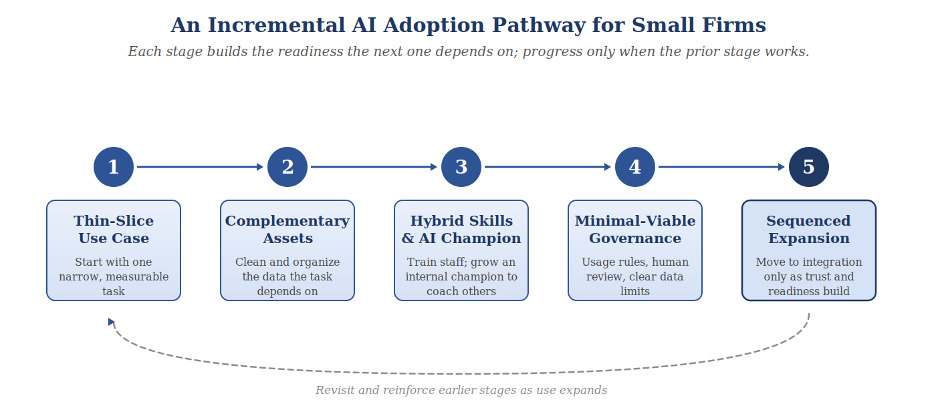
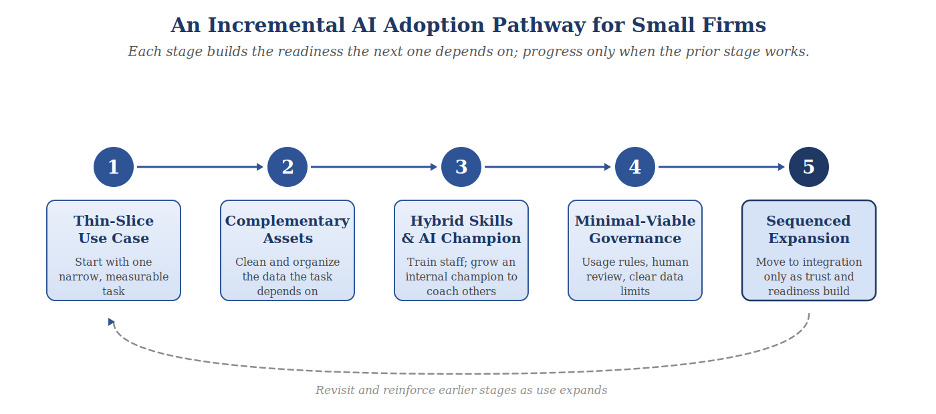
When the evidence is pulled together, four principles emerge wherever small firms report success. They run in sequence, and each one answers a constraint named earlier in this review—unclear ROI, weak data readiness, the skills gap, and the risk of overreach—so the framework emerges from the reviewed literature rather than from generic advice. See Figure 1.
Start With Thin-Slice Use Cases: Start with narrow tasks that have measurable outcomes. That answers the unclear-business-case barrier head-on by making the value visible fast. Research finds larger gains when AI is applied to clearly defined workflows (Brynjolfsson et al., 2025).
“We started with AI drafting job descriptions. Once that worked, we expanded.”
Invest in Complementary Assets: Data readiness and process redesign are prerequisites, not afterthoughts. This principle answers the data-readiness barrier and the resource-orchestration view (Peretz-Andersson et al., 2024).
“AI worked only after we standardized our customer data.”
Develop Hybrid Skills and AI Champions: Growing an internal “AI champion” who bridges the technology and the business answers the skills barrier from the inside, and training is consistently tied to better adoption (Ayinaddis, 2025).
“One employee became our AI expert and trains everyone else.”
Sequence Investments: Move from simple, low-risk tools toward more integrated automation only as readiness and trust build; sequencing this way lowers the risk of overreach (Peretz-Andersson et al., 2024).
“We started with writing tools, then automated workflows.”
An Emerging Option: Fractional AI Leadership: One emerging answer to the small-firm expertise gap is fractional, or part-time, AI leadership—sometimes called a fractional Chief AI Officer (CAIO)—where a firm brings in senior AI strategy and governance expertise on a part-time or per-project basis instead of through a full-time hire. Proponents argue that it gives smaller organizations capabilities they could not otherwise afford, at a fraction of the cost of a full-time executive. For now, though, the idea appears mainly in industry and consultancy sources rather than peer-reviewed research, and the evidence specific to small businesses is thin; It is flagged here as a practice to watch, not an established, evidence-based recommendation (Exec Capital, 2024).
Illustrative Practitioner Cases
The short cases below show the framework in practice. As the Method section explains, they are anonymized illustrative observations from the author’s professional experience and reflect patterns in the reviewed literature.
Case 1: Retail Marketing Automation
A small retail firm adopted AI for email campaigns and reported noticeably faster campaign creation.
“AI generates drafts instantly. We personalize them and send.”
Lesson. AI works in structured marketing tasks where the output is easy to review—a thin-slice entry point.
Case 2: Service Scheduling Optimization
A home-services company used AI scheduling tools and cut idle time.
“It optimized routes better than manual planning.”
Lesson. Operational value shows up once the data is organized—complementary assets first.
Case 3: Administrative Documentation
A consulting firm used AI for report drafting, saving time but raising accuracy concerns.
“We still review everything. AI speeds drafting but not judgment.”
Lesson. Human oversight stays critical accountability as a governance control.
Discussion
The evidence indicates that AI can deliver real benefits for small businesses when it is introduced step by step and matched to specific tasks, but also that adoption continues to run into the same three constraints: skills, data readiness, and governance. Practitioner accounts confirm that perceived value rests on visible time savings and ease of use, which aligns with SME adoption theory, which emphasizes practical utility over technological sophistication.
The unevenness of outcomes is the throughline of this review. AI is not a uniform benefit across firms. Firms with better-organized data, clearer task selection, and basic training get more out of it, while poorly matched use cases can drag it down. That is why the synthesis keeps pointing to readiness, sequencing, and oversight rather than to which tool to buy. AI adoption in small businesses is best understood as building a capability, not making a one-time technology decision.
Forward-looking outlook. Two near-term shifts are likely to shape small-business AI. First, capability is increasingly delivered through general-purpose, low-cost tools and AI features built into software firms already run, which lowers the entry barrier but raises the stakes on governance and verification habits. Second, responsible-use expectations—transparency, data handling, accountability—are shifting from a large-enterprise concern to baseline practice, making lightweight governance an early investment rather than a late one (OECD, 2024; Sarker et al., 2026). New support models such as fractional AI leadership may help close the expertise gap; their value for small firms remains to be demonstrated.
Implications for Small-Business Practice
Built on the patterns above, the practical implications group into three themes rather than a flat checklist, each tied to the evidence reviewed.
Capability building. Build internal skills before scaling: train staff, develop an AI champion, and bring in part-time external expertise where needed (drivers and barriers; Ayinaddis, 2025).
Governance readiness. Put light controls in place early—usage rules, human review, and clear limits on what data goes into a tool—and treat governance as an enabler, not a brake (governance and ethics; OECD, 2024; Sarker et al., 2026).
Staged adoption. Start with narrow, measurable tasks; get data quality right before automating; and sequence spending from simple tools toward integration (impact and framework; Brynjolfsson et al., 2025; Peretz-Andersson et al., 2024).
As a quick reference, those translate into a short checklist: (a) pick one measurable task to start; (b) clean and consolidate the data that task depends on; (c) keep a human reviewing outputs; (d) write a one-page usage-and-data policy; (e) name an AI champion; and (f) expand only after the first use case clearly works.
Future Research Directions
Some gaps remain. Causal evidence on AI’s impact in operations and logistics is thin compared with the knowledge-work studies. Low-cost governance models and templates for firms with no compliance staff remain underdeveloped. Training designed for micro-firms, and data strategies for the small datasets typical of small businesses, are largely unexplored. Emerging support models such as fractional AI leadership need study focused specifically on small firms, where the current evidence remains largely anecdotal. Closing these gaps would strengthen both the evidence base and the guidance available to small-business owners.
Conclusion
AI adoption among small businesses is rising but uneven. The reviewed evidence shows that targeted uses can improve productivity and service quality, yet success depends on organizational readiness, complementary assets, and basic governance more than on the tools themselves. The throughline is this unevenness: outcomes split sharply on how well firms match tools to tasks, prepare their data, and keep humans in the loop. Seen this way, AI works best for small businesses not as a standalone technology but as a capability built into workflows and human judgment—added step by step, governed lightly, and expanded only as it earns trust.
Acknowledgment of AI Use
The author used generative AI tools in a limited capacity to help with language editing and proofreading. All research, source selection, analysis, interpretation, and conclusions are the author’s own, and the author reviewed and verified the content of the manuscript.