Introduction
The debate over what defines economic freedom, its robustness, and its impact on economic development continues today. Economic freedom refers to the freedom that individuals, entrepreneurs, and businesses have, which is free from unnecessary government restrictions and predation. To that end, Hall and Lawson (2014) and Stansel and Tuszynski (2017) have reported that over 200 or more empirical studies are using economic freedom as a measure in the world and North America, with the majority indicating a positive relationship between the growth of the economy and numerous measures of entrepreneurial activities (Dempere & Pauceanu, 2022). However, what constitutes productive entrepreneurship and favorable regional development policies remains understudied. The extent to which human capital constitutes a regional effort in the context of the knowledge-based economy remains vague.
Firms need sufficient “capital” to be sustainable over time. While firm-level analysis is essential, the larger question faced by regions is how to build and support the necessary ecosystem that allows startups to succeed and flourish. Region leaders recognize that no exact formula exists for creating an entrepreneurial economy (Isenberg, 2010). The focus has shifted to building regional ecosystems since Florida and Smith Jr (1993) seminal work on regional development and the now-famous bohemian class index. Isenberg (2010) was the first to advance the idea that such an ecosystem strategy represents a novel and cost-effective strategy for stimulating economic prosperity (p. 1). The new framework recognizes the role of the entrepreneurial actor in creating the system and keeping such a system healthy, yet emphasizing the context by which enterprises flourish (Stam, 2015).
Furthermore, Mason and Brown (2014) state that in addition to entrepreneurial action, both the resource providers within the ecosystem and the entrepreneurial connectors (deal-makers, mentors, serial entrepreneurs, advisors and/or board members) within the ecosystem and the entrepreneurial environment of the ecosystem are most important as they facilitate information flow, resource mobilization, investment connection, and other networking opportunities with external groups.
More importantly, a holistic and dynamic approach to building regions can provide valuable insights into regional success. A recent study (Botella-Carrubi et al., 2024) demonstrated that the strength of connections between entrepreneurs and among firms, combined with the opportunity to develop and practice skills necessary for growth, is especially beneficial. The role of human capital and its interaction with institutional factors deserves our attention. It was noted by Stevens and Weale (2004) that “education is needed for people to benefit from scientific advances as well as to contribute to them” (p.164). Therefore, to support this, one should examine the impact of primary, secondary, and tertiary education on economic output, with educational attainment rates recognized as a key factor for prosperity. However, understanding the type of degree—whether graduate or undergraduate—related to regional entrepreneurial activity requires further clarification.
The Economic Freedom of the World has become a regional and international measure that explains how robust cultures and institutions support regional development (Dempere & Pauceanu, 2022; Sayed & Abedelrahim, 2024). The Economic Freedom of the World index measures the degree to which a country’s policies and institutions support personal choice, voluntary exchange, open markets, and protection of private property (Gwartney & Lawson, 2024). Although some question the early versions of the measure (De Haan & Sturm, 2000). De Haan and Siermann (1996) concluded that the link between economic freedom and economic growth depends upon the measure used. Furthermore, they found that investment is not related to indicators of economic freedom. We support Bradley and Klein (2016) call for new ways to measure the capture of economic freedom activities and their link to entrepreneurial activity. Research has yet to seek to link economic activity to more micro-indicators of economic freedom. This question is of the utmost importance since regions are seeking regional capabilities investments. Still, we need to learn more about what it takes to build regional capital beyond just a good investment idea.
Venture Capital (VC) continues to have a leading role in providing capital to a wide variety of enterprises, and it is known to be a driving force in the development of technologies. Venture capital research has been conducted to better understand the development of new ventures (Roberts, 1991; Ruhnka & Young, 1987) the reasons behind VC investments (Amit et al., 1998; Fried & Hisrich, 1994; Gupta & Sapienza, 1992; J. Hall & Hofer, 1993; Jain, 2001; Manigart et al., 2002; Shepherd et al., 2000), the success of venture entrepreneurs, their firms and venture capital investors (Dubini, 1989; Jain, 2001; Seppä & Laamanen, 2001; Shepherd et al., 2000; Shepherd & Zacharakis, 2002), and the role of VC investors and entrepreneurs and their relationship (Barry, 1994; Fried & Hisrich, 1995; Kirilenko, 2001; Lerner, 2022; Sapienza et al., 1995; Steier & Greenwood, 2000).
Although much research has been conducted on the reasons why venture capital firms invest in ventures and why a venture succeeds, limited research has been conducted in understanding the spatial relationship of such investments related to economic freedom variables, except by institutional economists and geographers (R. Florida & Smith, 1993; Kreft & Sobel, 2005; McMullen et al., 2008; Timmons & Bygrave, 1986). Furthermore, research has mostly been limited to international, and regional boundaries (Bengoa & Sanchez-Robles, 2003; Dutta & Williamson, 2016; Wang & Wang, 2012) without a conclusive answer regarding what might favor VC regional activity over another at the state level within the U.S.
Florida and Smith Jr (1993) are the only ones who looked closely at the significant relationship between VC investments and the location of venture capital firms and other environmental factors, such as the supply of nontraditional human sources of capital. Florida (2001) seminal work established the bohemian index with relationships between IT, human capital, high technology industries, and the geography of bohemia. The bohemian index is a quotient measuring the percentage of Bohemians or creative groups. It has been advanced as a micro-level indicator of regional freedom and the strength of its labor pool, supporting high-growth industries.
We hypothesize that economic freedom and education play important roles in regional economic development. Specifically, higher levels of economic freedom should lead to increased economic development, as measured by VC activity (VC deals and investments) and the creation of new businesses. This hypothesis has clear, testable implications. We find that both economic freedom and graduate education contribute to higher business activity. Our dataset also enables us to examine interaction effects and specifically test whether the impact of graduate-level education depends on the level of economic activity in that state.
We have compelling evidence demonstrating the significance of graduate education level and economic freedom in promoting economic development. Our findings also suggest that the influence of the creative class on economic development is marginally noteworthy. Furthermore, we have identified that the impact of graduate school education is contingent on the level of economic freedom.
Data and Empirical Specification
Data
Our data set compiles various sources by state from the U.S. Bureau of Labor Statistics, U.S. Census Bureau, Fraser Institute, Venture Capital Association, and Federal Reserve Bank of Minneapolis. The District of Columbia, Puerto Rico, and other similar territories were excluded due to their unique geographic characteristics and because they were not systematically represented in all the data used to test the hypotheses. Therefore, only the 50 states of the United States are included in our sample. Finally, at the time of this research, only data up to 2019 was fully available, limiting our analysis to the period from 2006 to 2019.
We measure economic activity (dependent variable) using three measures: 1) the number of venture capital deals, 2) the total dollar amount invested in venture capital deals, and 3) the number of new businesses formed in each state that year, all adjusted using population size in each state[1] to account for parity across states in the U.S. These data points were carefully selected because the literature has documented that they are strong and relevant indicators of regional economic development (R. L. Florida & Kenney, 1988). We elected to run the models using all three variables as independent models to inform the different weights further, each of these variables could contribute to the future study of regional economic development in the U.S. The total number of venture deals and the total amount of dollars each deal represented in a specific year for a particular state were obtained from the National Venture Capital Association’s[2] Annual reports. These data points were adjusted for population size for the reasons mentioned above. As a result, we created two variables: the total number of venture deals per capita and the total venture capital dollars per capita. Finally, the total venture capital dollars per capita variable was further adjusted using the 2006 consumer price index, published by the U.S. Bureau of Labor Statistics. This new variable reflected and accounted for the inflationary effect across the years[3] covered in our time study. Business formation data was obtained from a standard dataset called Business Formation Statistics (BFS) from the U.S. Census Bureau, developed at the Center for Economic Studies in collaboration with other economists. BFS tracks business initiation activity and the cycle from start-up to actual business formation[4]. It measures new employer firm births, meaning when a company application is approved and a business begins to operate. This variable was adjusted for the population size of each state for the reasons mentioned above. Summary statistics for all dependent and independent variables are shown in Table 1.
There are four main independent variables used in our analysis. As indicated in the introduction section, established Creative Class Theory is a subset of the theory of human capital, which states that people, not businesses, are the drivers of economic growth. It can be inferred that the creative class includes people with different ideas through their occupations, which is used as a quotient measuring the percentage of creative groups or types—something Florida highlighted as a micro-level indicator of regional freedom and the strength of its labor pool supporting high-growth industries. This variable was adjusted to represent a percentage of the total population of each state. On average, only 0.8245% of the population belongs to the creative class, despite some clear outliers. Our sample includes a state where 9.5438% of the population belongs to the creative class.
The two primary independent variables of interest are educational attainment and economic freedom. We initially created two variables representing the main educational degree credentials earned by the total population. While education is essential for individuals to benefit from scientific advances and contribute, educational attainment remains somewhat inconclusive. We examine the percentage of people with a college degree (average 18.92%) and those with a graduate degree (average 10.66%) relative to the total population by state. The final critical independent variable in our study is the Economic Freedom of the World index. The Fraser Institute tracks state policies by jurisdiction that serve as indicators of economic freedom. Frasier Institute tracks state policies by jurisdictions that are indicators of economic freedom as “the ability of individuals to act in the economic sphere free of undue restrictions.” The subnational index by state, also called Economic Freedom of North America, compares individual jurisdictions within the U.S. and employs ten variables[5] for state governments in government spending, taxes, and labor market freedom.
Finally, we use both year and state controls (dummy variables) because of the nature of the time study (2006-2019) and the extreme variability in state sizes, geography, and total population sizes. In total, we have 700 observations (state/years).
Methodology
Our primary hypothesis was whether the differences in the number of venture capital deals, the dollar amounts from these deals, and firm formations grew with the level of educational (bachelor’s or graduate degree) attainment and economic freedom across states in the U.S. We present empirical results using OLS estimators to test our hypothesis, including models with and without moderative effect (interaction). As stated earlier, we include several control variables.
The simple specification we test takes the following form:
Dependentit =
β0 + β1CCit + β2EF it + β3UGit + β4GRit + Σ14 αjY Rjit + Σ49 γjSTATEjit
Where Dependent is our dependent variable, and as described in the data section, it takes the number of venture capital deals (VCDeals), the amount of VC investment (VCInv), or the number of new business formations (BusForm). We run the model three times, each time using a different dependent variable. CC is the percent of the population in the Creative Class category; EF is the value of the Economic Freedom Index; UG is the percent of the population with a bachelor’s degree; GR is the percent with a graduate degree.
We use 13 dummy variables (YR) to control for time (14 years spanning our data) and 49 STATE dummy variables to control the 50 states in our sample. We also run our model, including an interaction term[6]:
Dependentit = β0 + β1CCit + β2EF it + β3UGit + β4GRit + β5 (EF it ∗ GRit) + αj Y Rjit* +Σ49 *γjSTATEjit
In our second specification, the additional coefficient captures the effect of changes in graduate-level education on economic freedom. Our hypothesis predicts that it will be positive and significant, indicating that as education levels rise, regional economic development is more likely in an economically free policy environment. We can also estimate how much of the overall difference between the groups is due to this graduate educational attainment effect.
Results
The empirical results of the simple model specification (equation 1) appear in Table 2. When the number of venture capital deals is used as the dependent variable, we find that the coefficient for the creative class (CC) variable is negative and highly significant (p-value <0.000). None of the other independent variables are significant. This negative significance might suggest that although the creative class contributes to innovation and the regional vibrancy (R. Florida, 2001; R. Florida & Smith, 1993), the type of entrepreneur, sectoral focus, and investment-readiness of startups seeking venture funding in the region do not necessarily align.
However, when we use the dollar amount of venture capital investment as the dependent variable, the story changes. The percentage of people in the creative class no longer has a significant effect. The coefficient for the graduate degree variable is significant at the 1% level and positive, indicating that a higher presence of graduate-educated individuals is associated with more investments in venture capital projects. In our last measure of economic development, which is the number of new business formations, we find that economic freedom and graduate school education have a highly significant (p-value <0.000) and positive effect. In addition, the percentage of residents in the creative class also correlates with a higher number of new business formations, although this coefficient is only significant at the 5% level.
In Table 3, we present results from the second model specification. We include our key interaction term between the degree of economic freedom (EF) and the percentage of the population with graduate school education (GR). The interaction term is negative and highly significant regardless of the independent variable used. The negative coefficient of the interaction term suggests that higher levels of economic freedom significantly diminish the positive effect of graduate school education on the dollar amount of venture capital investment and the initiation of new businesses. No significant relationship is observed when the number of venture capital deals is used as the independent variable.
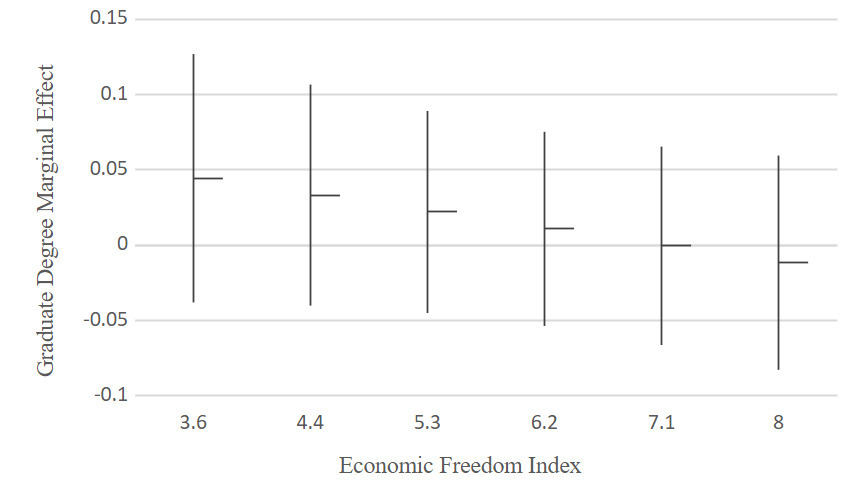


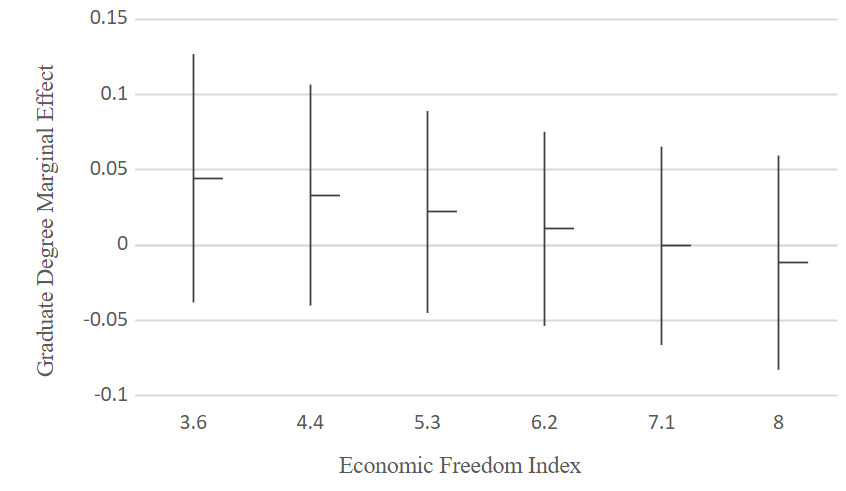
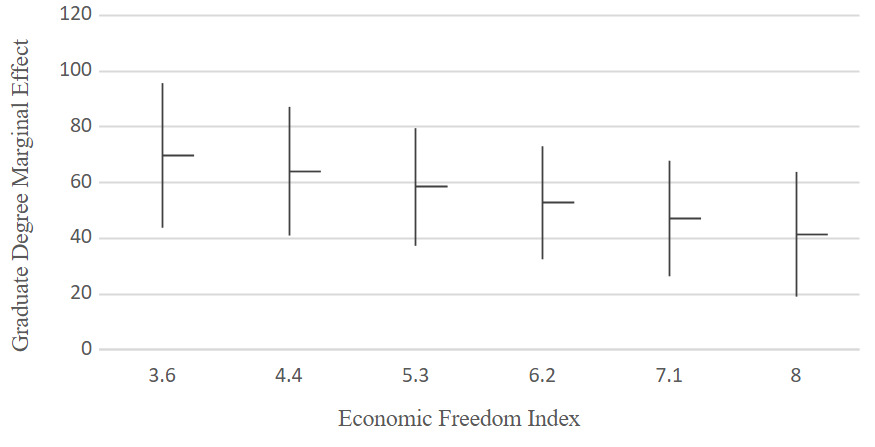
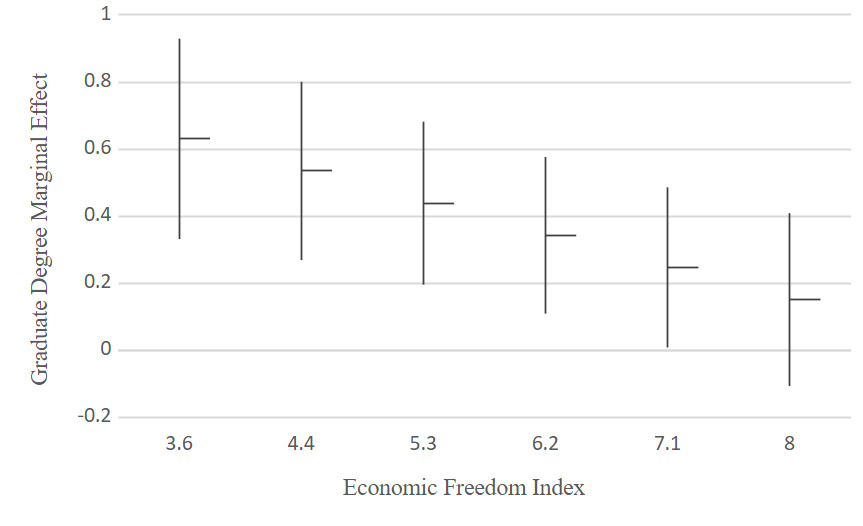
To explore this relationship further, we estimate the partial derivative of economic development with respect to graduate degrees for all values of the economic freedom variable, along with associated standard errors and significance levels. Our hypothesis aims to determine whether the impact of graduate education becomes less or more positive as economic freedom increases. We present our results in graphs in Figures 1, 2, and 3, each using different dependent variables.
As expected, and presented earlier in Table 3, there is no significant relationship when we use the number of venture capital deals as the dependent variable (Figure 1). However, we get some interesting insights when we use the other two independent variables. Results for the venture capital dollar investments appear in Figure 2. At low levels of economic freedom, the estimated marginal effect of graduate school education is high, positive, and significant (p-value<0.000) and it becomes lower, but still highly significant, at higher levels of economic freedom.
When we use the number of new business formations as the independent variable (Figure 3), the pattern remains similar. At low levels of economic freedom, graduate school education has a positive and significant effect. This effect decreases as the level of economic freedom rises and becomes insignificant at the highest levels of economic freedom (above 7).
Conclusions
While the importance of economic freedom on entrepreneurial activities is well documented (Bradley & Klein, 2016; De Haan & Sturm, 2000; Dempere & Pauceanu, 2022; Kreft & Sobel, 2005; Sayed & Abedelrahim, 2024), what constitutes productive entrepreneurship remains understudied, especially regarding the extent to which human capital remains a significant factor.
We hypothesize that economic freedom and education are key factors in regional economic development. We tested and found that both economic freedom and graduate education lead to higher business activity across the 50 U. S. States. This might be explained by studies that found that high education levels significantly increased the likelihood of securing funding and make intellectual and social capital available (Everett, 2024; Ramos-Rodríguez et al., 2011). Furthermore, we found compelling evidence demonstrating the importance of graduate education level and economic freedom in driving economic development (VC activity). The results suggest that the influence of the creative class on economic development is marginally noteworthy, while the impact of graduate school education depends on the level of economic freedom.
Our results suggest that both graduate education and economic freedom are important for economic development. Graduate school education becomes even more vital as economic freedom decreases. We see no evidence that undergraduate education is significant. Additionally, there is weak evidence that residents in the creative class contribute positively to economic development, especially when measured by the start of new businesses. More importantly, the impact of graduate education varies depending on the level of economic freedom. In states with low economic freedom, having more people with graduate degrees is essential to offset weak institutions. In states with high economic freedom, the presence of graduate-degree holders does not significantly influence economic development because the ecosystem already supports innovation and entrepreneurship.
Our research has several limitations that affect future studies. While time studies help us measure economic activity over time, they have important constraints. Most notably, they cannot capture changes in statistical properties throughout the study period. We recognize that this research is confined to the timeframe shown and does not include major global economic events like COVID-19; it also may not be applicable to other regions since it uses data from US states. Future studies could explore the impact of such global shocks on human capital and entrepreneurial economic activity, possibly by comparing with other indexes, such as the Misery Index (Katzmann & Veres, 2021; Núñez & Morales-Alonso, 2024; Pavlik, 2024). It is also recognized that economic indices can sometimes be influenced by assumptions, revisions, or manipulations. The indices used in this study are widely utilized by many agencies for forecasting and analysis, making them acceptable for this research. The education data (undergraduate or graduate) was limited in detail. Future research could explore how different types of graduate degrees affect VC deals in areas with low economic freedom. We acknowledge the need for more substantial and consistent evidence linking graduate-level education to business launch outcomes, as well as the relationships between founders, policymakers, other ecosystems, and education. Lastly, it is important to note that the sample is only limited to the 50 U.S. states, which constrains the ability to generalize the findings.
US Census Bureau. Last accessed January 20, 2023
National Venture Capital Associations Yearbook. Last accessed December 18, 2022 http://www.nvca.org
Consumer Price Index, 1913- (2023) Last accessed January 31, 2023 https://www.minneapolisfed.org/about-us/monetary-policy/inflation-calculator/consumer-price-index-1913
The ten variables are 1) consumption spending (% of personal income), transfers and subsidies (% of personal income), insurance and retirement payments (% of personal income), income and payroll tax revenue (% of personal income), top income tax rate, property tax and other tax revenue (% of personal income), sales tax revenue (% of personal income), minimum wage income ( % of per capital personal income), government employees (% of total employees), and union density (% of total emplpoyees).
We have also attempted to use other interactions interacting the EF variable with the percentage of the population with bachelor’s degrees and with the Creative class category. All interactions were insignificant. Results are available from the authors upon request.